
Why Don't I Feel Safe in Relationships, Even When I Know I'm Safe?
You might know you're safe in a relationship, yet still find yourself anticipating rejection, overthinking conversations or pulling away. Explore how earlier relational experiences can shape the protective parts of us, and why knowing we're safe doesn't always mean feeling safe.
You can know that a relationship is safe and still not feel safe because parts of you may be responding to what relationships have taught you to expect, rather than only to what is happening now.
You might trust the person you're with. You might know they care about you. There may be no obvious threat in the relationship at all.
Yet a change in their tone, a disagreement, a delayed reply or a feeling that they're disappointed in you can bring up a response that feels much bigger than what is happening in the moment.
You might find yourself overthinking what you said, looking for signs something is wrong, needing reassurance, shutting down, pulling away or preparing yourself for rejection.
Part of you might even be thinking:
I know I'm safe. So why am I reacting like this?
Sometimes, the answer isn't only in what is happening now.
When past relationships shape what we expect now
Relational trauma isn't only about the things that happened to us. It can also be shaped by what we needed in relationships and didn't consistently receive.
Safety. Comfort. Protection. Validation. Attunement. Having our feelings taken seriously. Being able to need another person without that need being ignored, criticised or becoming too much.
When important relationships have instead involved unpredictability, criticism, rejection, emotional absence or fear, we can learn ways of protecting ourselves.
Keep the peace.
Don't need too much.
Watch for changes.
Don't let people get too close.
Deal with things yourself.
Those responses don't necessarily disappear simply because our circumstances change.
Why can something small feel so big?
I often think about this through a parts-informed lens.
There might be a part of you that watches closely for rejection. A part that works hard to keep everyone happy. A part that withdraws before somebody can hurt you. Or a younger part that still carries fear, loneliness or hurt from earlier experiences.
Sometimes something happening now becomes a cue for something learnt then.
A change in your partner's tone may simply be a change in tone. But a part of you may recognise something familiar and begin preparing for what it learnt could come next.
That's one reason telling yourself “I'm safe” doesn't always make the feeling disappear.
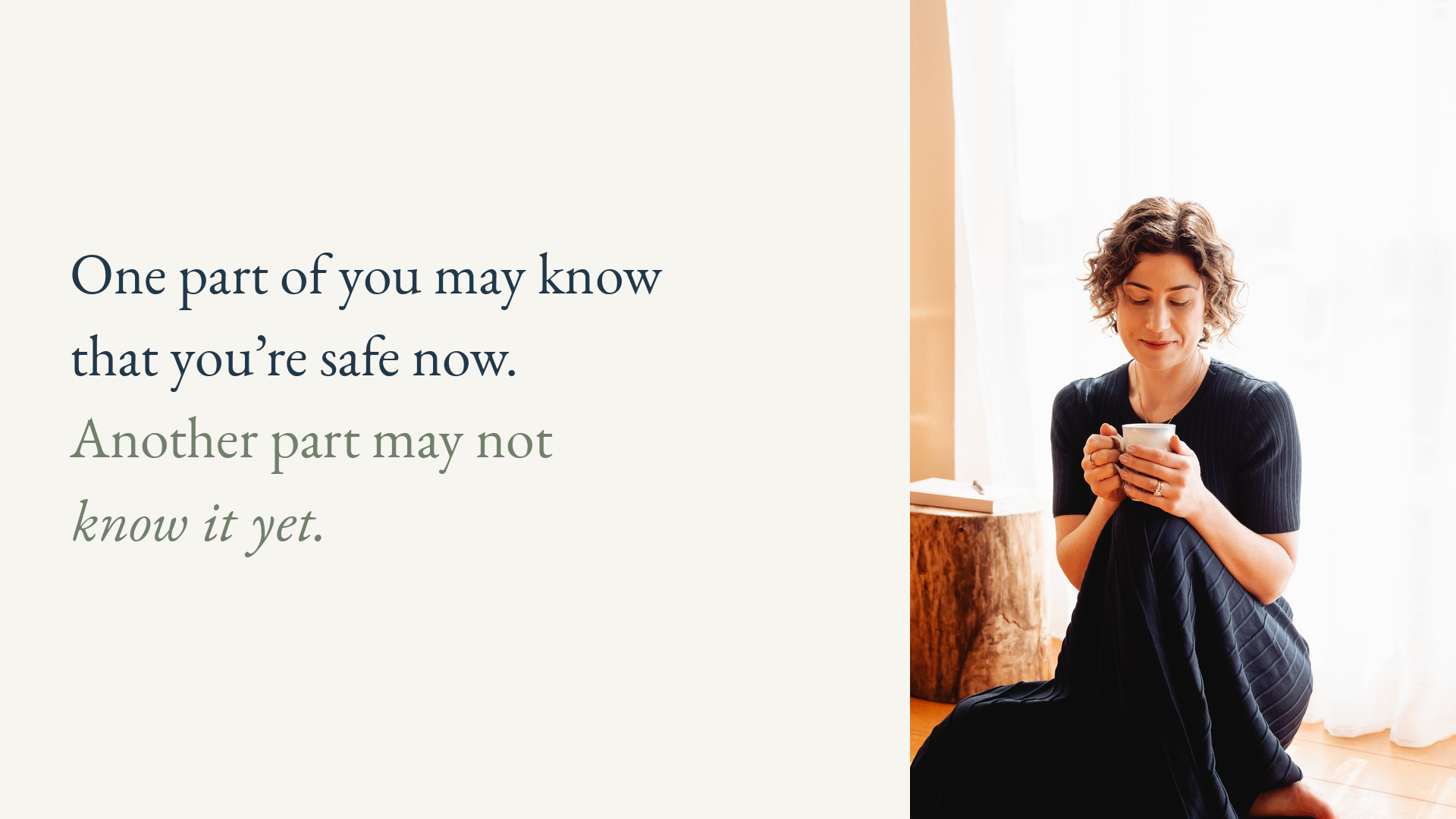
One part of you may know that you're safe now. Another part may not know it yet.
Can therapy help me feel safer in relationships?
Therapy doesn't have to be about trying to convince these responses to go away.
Instead, we can become curious about the parts of you that continue to protect, what they are responding to, and what they might need to begin to experience something different now.
In my work, I draw on parts-informed therapy (Resource Therapy)and Relational Integrative EMDR. We work at a pace that feels manageable, with attention to safety, the therapeutic relationship and what your protective parts may need along the way.
Sometimes this might include gently exploring earlier experiences connected with the responses that continue to show up now, while creating space for what may not have been available then: safety, protection, validation, connection or choice.
The aim isn't to erase what happened.
It's to create more space to respond to the relationship you're in now, rather than only from what relationships have taught you to expect.
Written by Jaclyn Hall
Jaclyn Hall is a PACFA Accredited Clinical Counsellor, PACFA Certified Supervisor, EMDRAA Accredited EMDR Practitioner and Advanced Clinical Resource Therapist.
Jaclyn is the founder of Calm, Connect & Heal Therapeutic Services, based in Blaxland in the Blue Mountains, NSW. She specialises in trauma and relational trauma, drawing on parts-informed approaches, Resource Therapy and Relational Integrative EMDR.
She offers counselling, EMDR therapy, clinical supervision and professional training, with services available in person and online.
Disclaimer: This article provides general information and is not a substitute for individual mental health advice.
Professional Resources
Below are a selection of professional organisations and educational resources related to trauma therapy, EMDR, counselling, dissociation and mental health support.
EMDRAA – EMDR Association of Australia
https://emdraa.orgPACFA – Psychotherapy and Counselling Federation of Australia
https://pacfa.org.auBlue Knot Foundation
https://blueknot.org.au
Crisis & Immediate Support
If you or someone you know requires immediate mental health support, the following services are available:
NSW Mental Health Line (24/7)
1800 011 511Lifeline Australia
13 11 14
https://lifeline.org.au1800RESPECT
1800 737 732
https://1800respect.org.au
If you are in immediate danger or require urgent assistance, call 000.