
Do I Have to Talk About My Trauma in EMDR?
Worried about discussing painful memories in EMDR? Learn how EMDR works and how Jaclyn Hall approaches relational and parts-informed therapy in the Blue Mountains.
For some people, the thought of beginning trauma therapy can feel overwhelming.
Perhaps you've spoken about what happened before, but still notice its impact. Or maybe there are experiences you've spent years trying not to think about.
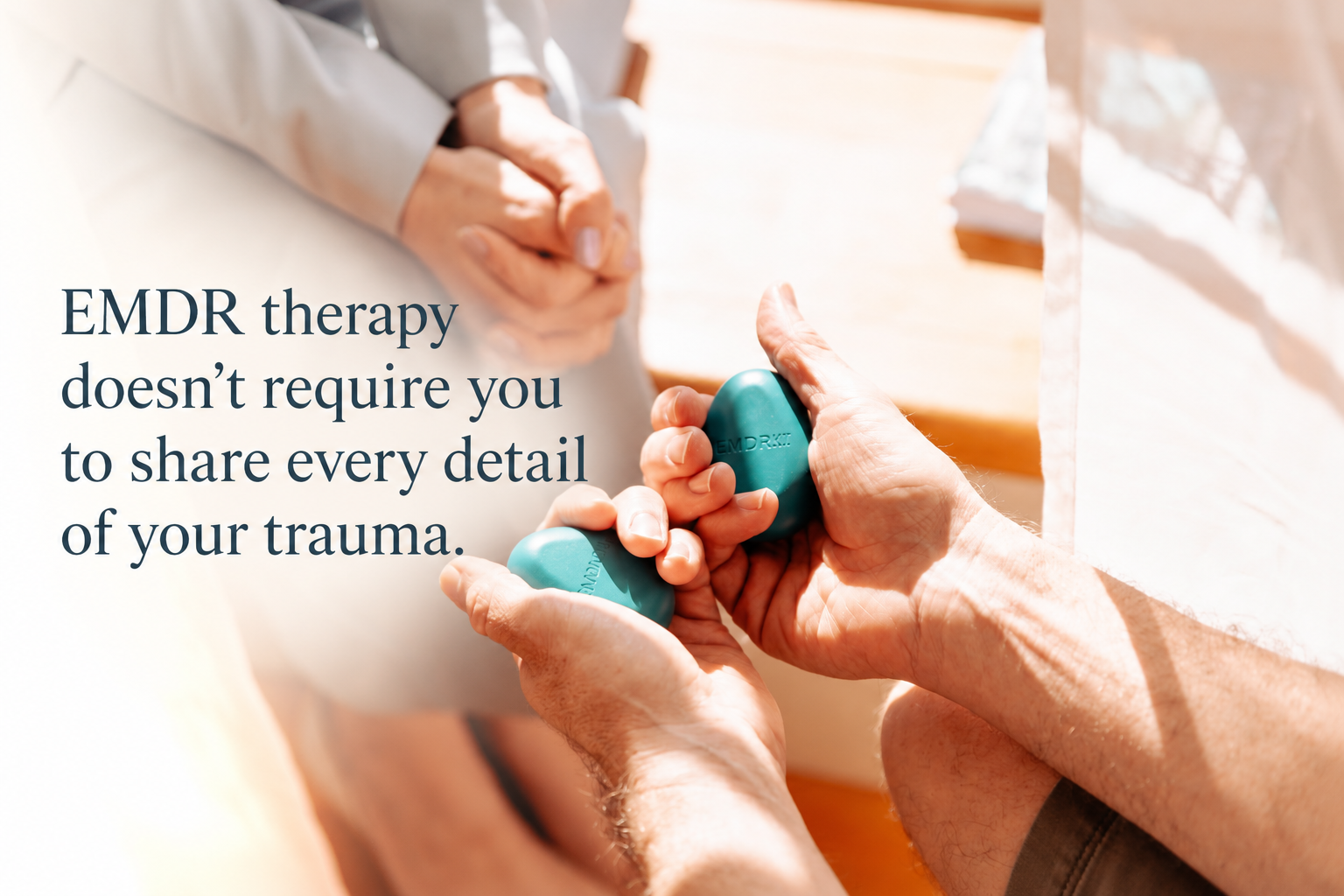
No. EMDR therapy doesn't require you to describe every detail of a traumatic experience. There is also much more to EMDR than revisiting painful memories.
How does EMDR therapy work?
EMDR (Eye Movement Desensitisation and Reprocessing) is an evidence-based therapy that helps people process distressing experiences and reduce their ongoing impact.
Sometimes, even when we know something happened in the past, we continue to feel its effects in the present.
This might show up as anxiety, difficulty trusting others, feeling constantly on guard, or beliefs such as I'm not safe or I'm not good enough.
EMDR follows an eight-phase approach that includes understanding your history, preparation and memory processing using bilateral stimulation, such as hand held buzzers, guided eye movements or alternating taps.
What if I'm not ready to revisit difficult memories?
You don't need to arrive knowing which memories to work on or feeling ready to share your most painful experiences.
Preparation is an important part of EMDR. We can spend time understanding what's happening for you, exploring what support you might need and developing resources before approaching difficult memories.
There isn't a set number of sessions you should need before beginning memory processing. We can work together to consider what feels appropriate for you.
What is Relational-Integrative EMDR?
My approach is informed by Relational-Integrative EMDR (RI-EMDR), developed by Michele Bowes and Amy English through SEVA Training.
RI-EMDR remains grounded in the eight phases of EMDR while integrating attachment-informed practice, parts work, nervous system awareness, imagery rescripting and the therapeutic relationship.
One of the things I particularly value about this approach is that it recognises how trauma can be connected to experiences that happened to us, but also what we needed and didn't receive.
Perhaps there wasn't someone to offer comfort when you were frightened, protection when you felt unsafe, or reassurance when you were struggling.
These experiences can shape how we feel about ourselves, what we expect from relationships and the ways different parts of us have learnt to cope.
Sometimes one part of us might desperately want things to change, while another feels frightened about what might happen if we let our guard down.
Rather than pushing past these protective responses, we can take time to understand their concerns and what they might need.
The therapeutic relationship is also an important part of this work. We pay attention to how you're experiencing the process together, recognising that being heard, understood and responded to can be especially meaningful when these experiences were missing in earlier relationships.
Where appropriate, imagery rescripting can offer opportunities for parts of self to experience something different from what happened originally, such as protection, comfort, connection or choice.
Throughout the work, we pay attention to your emotional and physical responses, allowing these to inform the pace and direction of therapy.
Considering EMDR therapy?
You don't need to have everything figured out before starting.
Further reading: EMDR Association of Australia
Written by Jaclyn Hall
Jaclyn Hall is a PACFA Accredited Clinical Counsellor, PACFA Certified Supervisor, EMDRAA Accredited EMDR Practitioner and Advanced Clinical Resource Therapist.
Jaclyn is the founder of Calm, Connect & Heal Therapeutic Services, based in Blaxland in the Blue Mountains, NSW. She specialises in trauma and relational trauma, drawing on parts-informed approaches, Resource Therapy and Relational Integrative EMDR.
She offers counselling, EMDR therapy, clinical supervision and professional training, with services available in person and online.
Disclaimer: This article provides general information and is not a substitute for individual mental health advice.
Professional Resources
Below are a selection of professional organisations and educational resources related to trauma therapy, EMDR, counselling and mental health support.
EMDRAA – EMDR Association of Australia
https://emdraa.orgPACFA – Psychotherapy and Counselling Federation of Australia
https://pacfa.org.auBlue Knot Foundation
https://blueknot.org.au
Crisis & Immediate Support
If you or someone you know requires immediate mental health support, the following services are available:
NSW Mental Health Line (24/7)
1800 011 511Lifeline Australia
13 11 14
https://lifeline.org.au1800RESPECT
1800 737 732
https://1800respect.org.au
If you are in immediate danger or require urgent assistance, call 000.